
Ten years of cheap electronics, and a new €3 charge that quietly makes the whole habit pointless.
I’ve been buying from AliExpress since November 2015. My first order, for the record, was a €1 bag of replacement screws for a MacBook — the sort of thing no shop near me stocks and no sane person pays shipping for. That pretty much set the tone for the next decade.
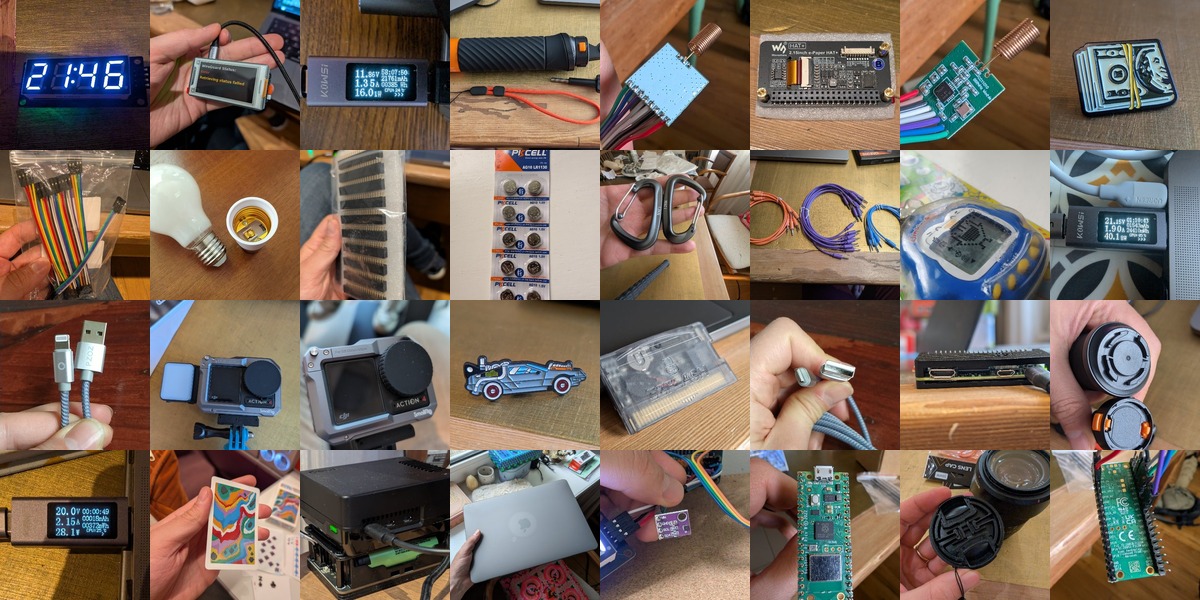
I pulled my whole account history the other day and counted 322 orders. Just under €5,000 over ten years, which sounds like a lot until you look at what it actually was: jumper wires, GPIO headers for a Raspberry Pi, solder, a handful of sensor boards, plastic sleeves for my game cartridges, little displays you genuinely can’t buy here in the Netherlands without paying three times the price. Supplies, basically — the raw material for a hundred small weekend projects. There were a couple of real splurges buried in there too — a brand-new iPhone, the odd used MacBook SSD — but mostly it’s a long, boring list of things that cost a euro or two.
For all that it comes to ten years and nearly €5,000, the median order was about €5. Almost half of everything came in under that, fifty-odd orders were under €2, and the cheapest was a literal one cent. The most expensive single thing in a decade was that new iPhone, at €499 — the exception that proves how small the rest of it is. That’s the shape of it: a steady drip of tiny parcels, around thirty a year, with the occasional proper purchase thrown in.
On 1 July 2026 the EU changes the rules in a way that makes that kind of shopping stop adding up. So I’m winding the account down. Here’s the thinking.
What changes in July
Until now, anything under €150 came into the EU without customs duty. From July that exemption is gone, and every parcel from outside the bloc picks up a flat €3 customs charge.
Three euros doesn’t sound like much. The catch is in how it’s counted — it isn’t €3 per parcel, it’s €3 per type of item, by tariff code, the eight-digit classification customs uses to file everything. So a box with a memory card, a dev board, a roll of solder and a bag of jumper wires isn’t one €3 charge. It’s four.
And it’s only the opening move. A separate handling fee of around €2 per item is expected later in 2026, which would push the real number toward €5 per item type. The whole arrangement is officially “temporary” until 2028, when it gets swapped for a tiered system.
Combining orders doesn’t help
My first instinct was that this wouldn’t really touch me, because AliExpress already bundles orders placed around the same time into combined parcels. So I checked. My 76 orders this year actually shipped in about 20 boxes — one tracking number covered thirteen separate orders from the first of June alone.
It makes no difference. The fee follows the tariff code, not the box, so thirteen different products are thirteen charges whether they turn up together or not. If anything the tax is designed to punish exactly the way a tinkerer shops: lots of small, different things.
The fee is bigger than the thing
Because it’s flat, it lands hardest on the cheapest stuff. A few real examples from this June:
| What I bought | What I paid | With the new fee |
|---|---|---|
| 40-pin male header strip | $0.45 | +€3 (~+720%) |
| Dupont jumper wires (40×) | $0.72 | +€3 (~+450%) |
| Female header socket | $1.24 | +€3 (~+260%) |
| CC1101 wireless module | $1.36 | +€3 (~+240%) |
A 45-cent strip of header pins becomes a €3.70 strip of header pins. The fee is bigger than the thing you’re buying, several times over.
Add it up across this year and the duty alone would cost me about €228 on roughly €590 of spending — call it a 40% surcharge — and that’s before the handling fee, and on top of the 21% import VAT the EU already added back in 2021 when it scrapped the old €22 threshold.
That VAT always nagged at me, if I’m honest. I pay the full 21% — the same as I would in a Dutch shop with a two-year guarantee behind the counter — on a €2 part from a seller in Shenzhen whose practical warranty lasts about as long as AliExpress’s buyer-protection window. A couple of months, and after that you’re on your own. On paper, EU law gives these goods the same two-year guarantee as anything else; enforcing it against a seller on the other side of the planet is another matter entirely. Full tax, a fraction of the protection. That never quite sat right with me either.
A decade, in one chart
While I had the data open, I plotted the whole ten years:
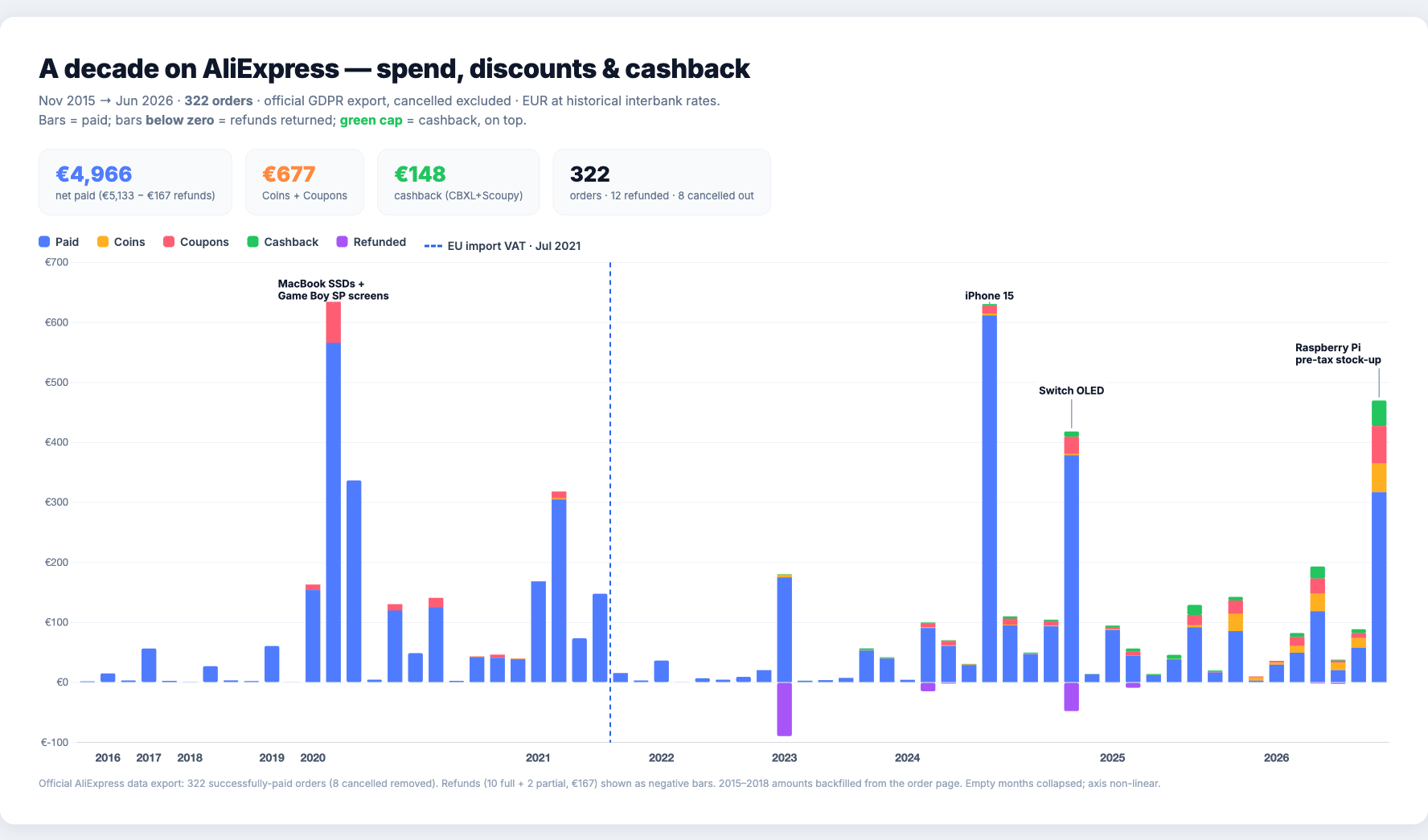
You can more or less read my life off it. The big spike in early 2020 is a Game Boy Advance screen-modding phase sitting on top of a couple of used MacBook SSDs — used because they’re the proprietary blades Apple never sold separately, so second-hand is the only way. The two tall bars in 2024 are the things that aren’t cheap parts — a brand-new iPhone 15 (a Hong Kong model) and a Switch OLED (I ordered two, one got cancelled). The little run in 2023 is retro Tamagotchis: the exact model I had as a kid, bought purely out of nostalgia and left sealed in the box. And that last spike in June 2026 is me stocking up on Raspberry Pi bits before the tax lands. Fittingly, it turned out to be the single busiest month of the whole decade — 38 orders, a proper panic-buy — and it’s what sent me down this rabbit hole in the first place.
What else the data showed
A few things surfaced once I had it all in a spreadsheet. Out of 322 orders, twelve went wrong enough that I opened a dispute, and ten of those ended in a full refund — those are the little dips below the line on the chart. Four were the classic “tracking says delivered, parcel never arrived”; a couple were dead-on-arrival electronics; the rest were one-offs (damaged in the post, wrong model, that sort of thing). For a decade of buying the cheapest electronics on earth, that’s a soft failure rate.
I’d also, apparently, written 162 reviews and asked 45 questions on product pages, which tells you roughly how much of my life has gone into this.
And none of the spending figures include cashback. I always routed purchases through CashbackXL and Scoupy and clawed back about €150 that way over the years, on top of AliExpress’s own coins and coupons — so the real damage was a fair bit lower than the totals suggest.
I’m not who this is for
I do understand what the tax is for. It’s aimed at the Shein and Temu firehose — something like 4.6 billion sub-€150 parcels poured into the EU in 2024, the overwhelming majority from China, plenty of it failing safety rules and undercutting local shops. Tax that, by all means.
But a flat per-item fee doesn’t hit the firehose hardest. It hits me hardest. My 45-cent header pins aren’t undercutting European industry — there is no European shop mailing me a single strip of header pins for 45 cents. The big platforms will fold €3 into a “service fee” and keep shipping fast fashion by the container. The person who actually feels it is whoever’s ordering a €1.40 part to finish something on a Sunday afternoon.
The low-emission-sticker problem
It reminds me of Europe’s low-emission zones, and that comparison is exactly why I don’t trust how this will play out. Cleaner city air is a fine goal. The execution is 27 incompatible national schemes: France has its Crit’Air sticker, Germany its Umweltplakette, the Dutch and Belgians their own camera zones, each with its own form and its own rules. Rent a car in Amsterdam and it has none of them, which means you can’t legally drive into Lille, or the centre of most big German cities, without ordering two different stickers from two different bureaucracies in advance — for a car you’ve got for three days. A sensible aim, implemented so bluntly that a perfectly law-abiding person doing an ordinary thing becomes an offender.
It’s a pattern. GDPR was a genuinely good law that somehow became a cookie banner on every website on earth. The €22 VAT change was sold as fairness and mostly meant my €2 parcels turned into €2.50 parcels. Every time, the intention is reasonable and the instrument is a sledgehammer that misses what it’s swinging at and clips the small, compliant person standing next to it. Whoever wrote a €3-per-tariff-code rule has clearly never tried to buy a 45-cent component.
So I’m winding it down
That’s about it. Ten years, 322 orders, a genuinely useful pile of cheap parts, and a way of shopping that simply stops working in July. I’m not deleting the account — I just won’t feed it any more. I exported everything, saved it, and I’ll let it go quiet.
The big platforms will be fine. The hobbyist won’t. As usual.
The numbers here come straight from my own AliExpress data export — 322 paid orders, November 2015 to June 2026, with cancelled orders dropped and refunds netted out, converted to euros at historical rates. If you want the actual rules rather than my grumbling: the EU Council decision, the Commission’s guidance, and a plain-English explainer from vatcalc.
