
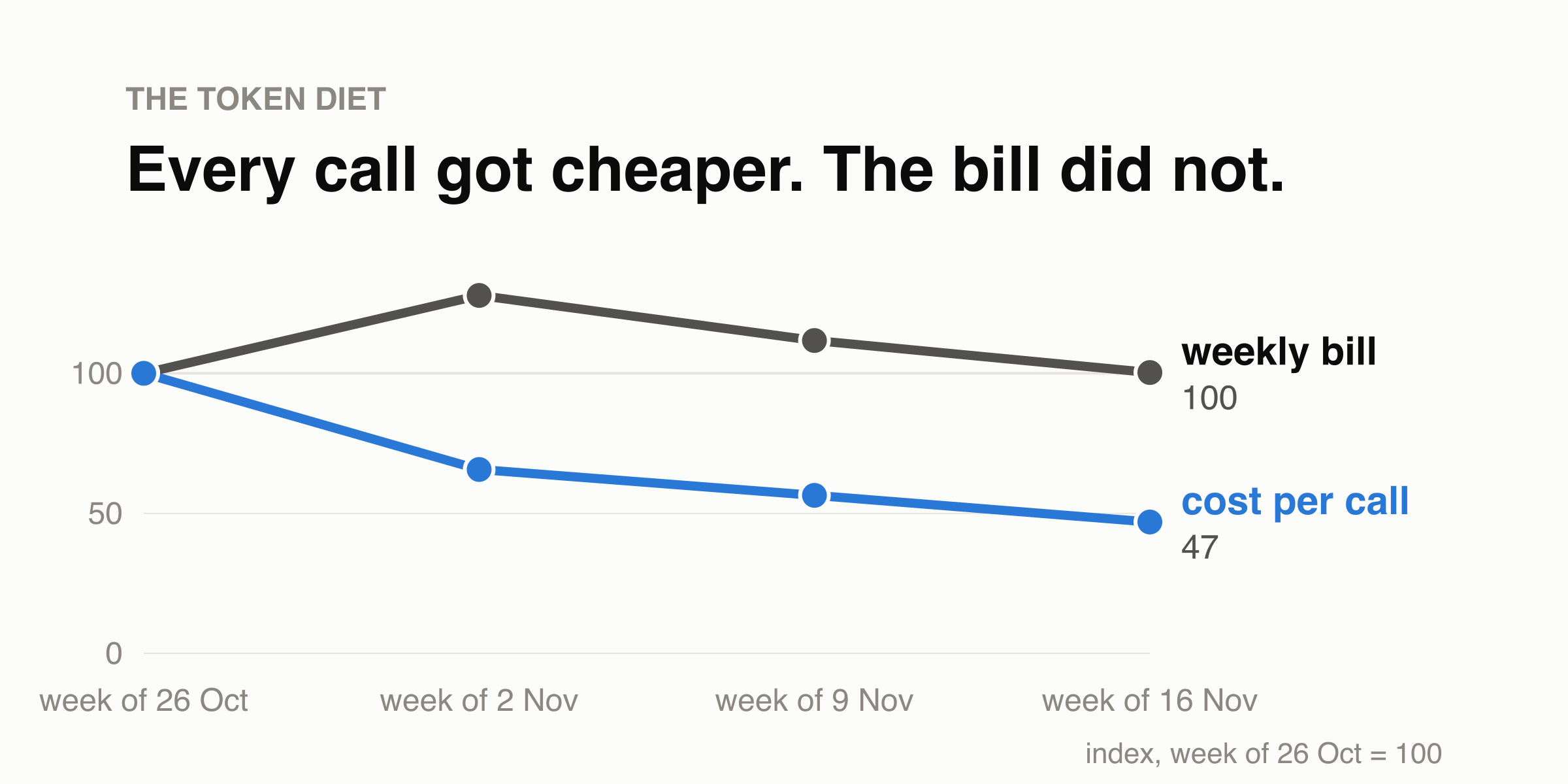
This month I put my coding agent on a diet. The instructions it reads at the start of every session lost two thirds of their weight, its helper agents stopped carrying every tool they own, and knowledge it used to load all day now loads only when a task needs it.
Each API call now costs about half what it did a month ago. My weekly bill did not go down: $1,349 in the last week of October, $1,357 in the week of 16 November. What changed is what it buys. In October my weekly allowance ran out after three working days. Now it lasts four, my whole working week. That was the reason for the whole exercise: tokens for every working day, while doing more work, and reviewing it harder, than ever before.
This is the latest in the AI-agent series; the last one, We Find Them Faster Than We Fix Them, was about what cheap checking turns up. This one is about the meter. The numbers come from the agent’s own transcripts: 57,918 API calls and 446 subagent runs over 30 days.
I run on a subscription, so there is no invoice. I count quota units: one fresh Opus input token is one unit, a cache read is a tenth, and cheaper models weigh less (Sonnet 0.2, Haiku 0.05). My own weights, not prices, but the same before and after.
Every call re-reads everything
A language model has no memory between calls. Each step sends the whole conversation again, from the system prompt to the last tool output. Caching makes that cheap but not free, and 97% of what I send is a cache read. So whatever sits at the top of a session is a tax on every step after it. Anthropic’s guide to context engineering says the same thing from the other side: keep the set of tokens small and high-signal.
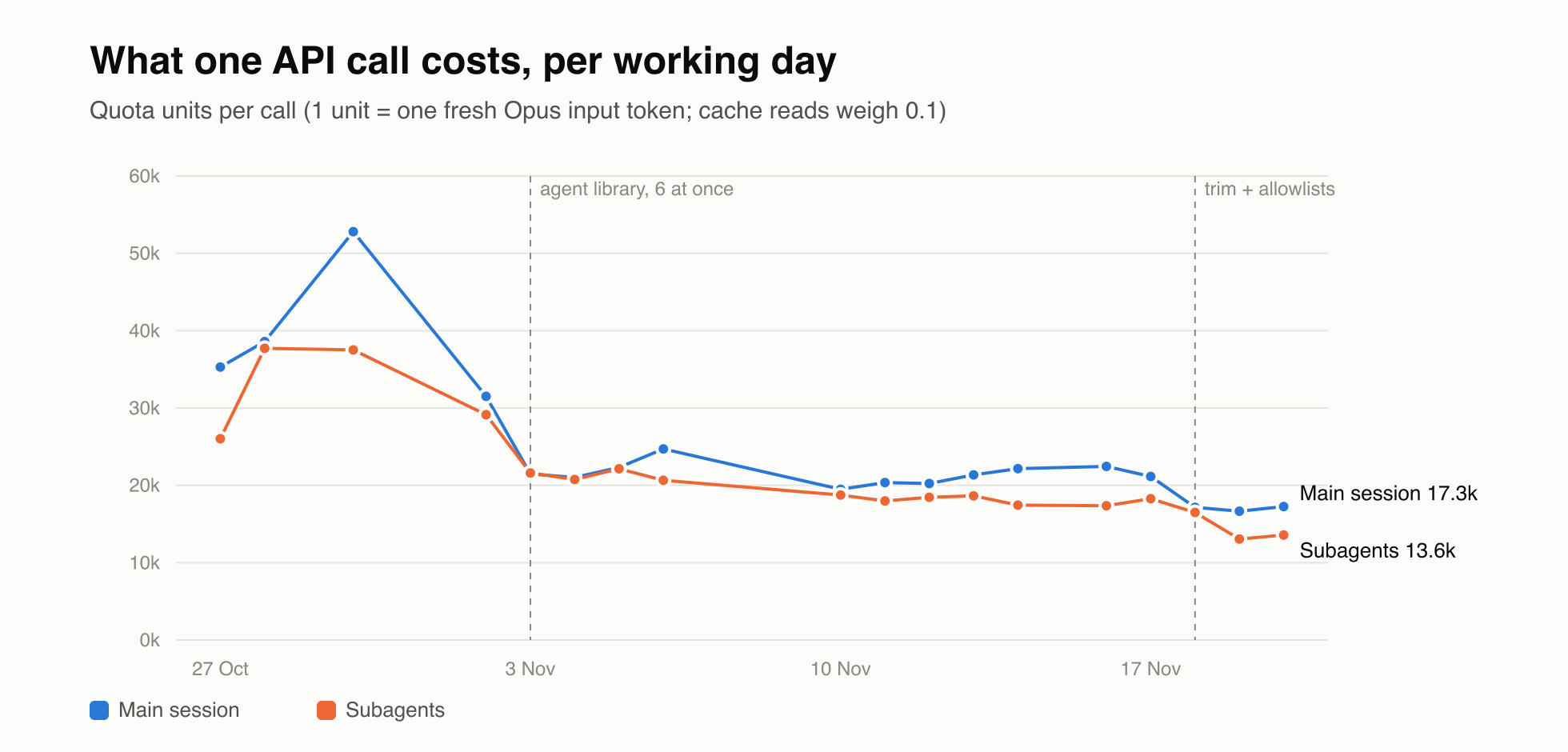
Quota units per API call per working day, main session and subagents. Main falls from 32 to 53k in late October to about 17k; subagents from 26 to 38k to 13 to 16.5k. Dashed lines mark 3 Nov (agent library, 6 at once) and 18 Nov (trim and allowlists).
Two steps are visible: 3 November (the agents) and 18 November (the context).
Step one: agents that know their job
From 24 October to 2 November, nearly all delegated work went to a generic agent on the biggest model, with every tool loaded, up to 40 at once. Generic agents used 98% of subagent tokens: 52 runs, 1.3 billion tokens.
The fix was an agent library. Claude Code lets you define subagents as short files with one job, one model and one list of tools. Mine: a ticket builder, a PR lander, a warehouse analyst and a security reviewer on Opus; an inbox checker and the built-in web fetcher on Haiku.
A hook blocks every launch of a generic agent; another proposes a new specialised agent when the same kind of task keeps coming back. One generic run slipped past on 4 November, started by a built-in review command that skips the hook: 0.14% of that fortnight’s tokens. The same day I cut concurrency from 40 to 6.
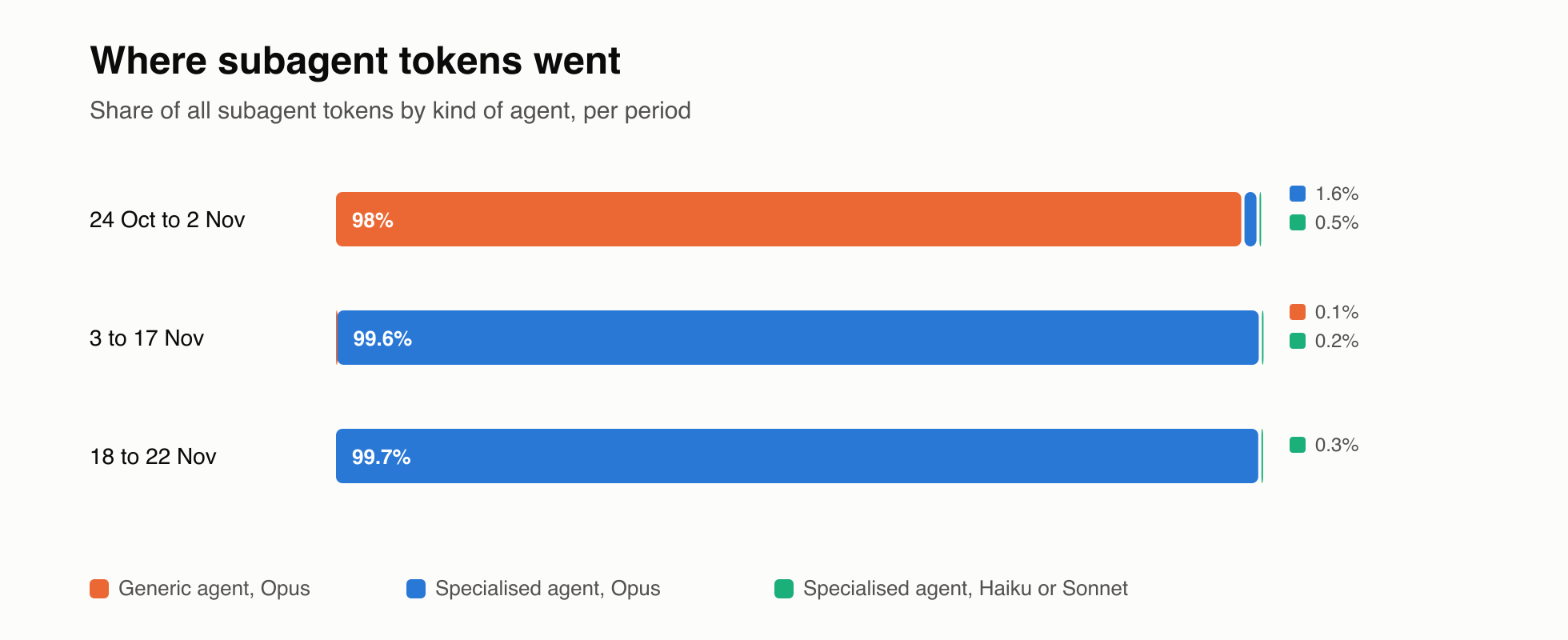
Share of subagent tokens by kind of agent. 24 Oct to 2 Nov: 98% generic Opus. 3 to 17 Nov: 99.9% specialised (one generic run, 0.14%). 18 to 22 Nov: 100% specialised.
The Haiku slice is under 1%. Cheap agents do cheap work; the money was in the generic agent carrying the whole house for a task that needed one room.
Step two: a smaller suitcase
Two files load into every session before I type a word: the instructions file and the memory index. Both had grown one useful line at a time.
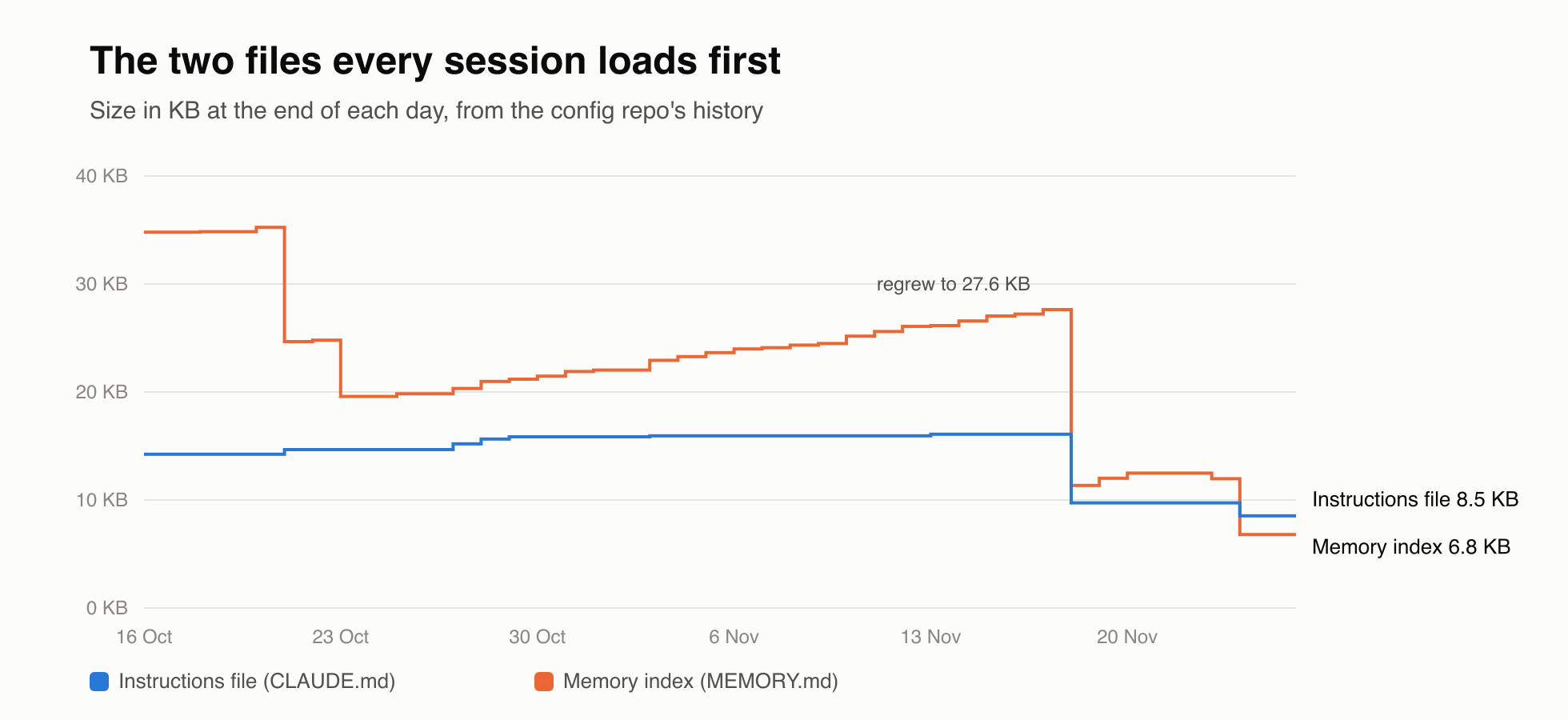
Size of the instructions file and the memory index at the end of each day. The memory index was cut to 19.6 KB in late October, regrew to 27.6 KB by 17 Nov, fell to 11.4 KB on 18 Nov, was back at 12.5 KB two days later, and was cut under a hard budget to 12.0 KB on 23 Nov and 6.8 KB on 24 Nov; the instructions file went from 16.1 KB to 9.7 KB on 18 Nov and 8.5 KB on 24 Nov.
I had cut the index once already, in October (the story is in The Human Context Limit). It grew straight back, because every new fact went to the one place guaranteed to be read. So in November I changed where things go:
- Topic files. The instructions file keeps only rules for every session, plus pointers to 23 topic files (about 200 KB) read only when needed.
- Skills. Knowledge for one kind of task became a skill, loaded only when the task matches. Six in four days, about 100 KB that costs nothing until used.
- No dumps. A start-up hook that listed all 444 memory files (43 KB) now prints one line.
- Tool allowlists. Tool definitions are text too. An agent with every tool started at 61k tokens; with a list, 24k.
That was not enough: two days later the index had grown from 11.4 KB to 12.5 KB. So it got a hard budget of 12,000 bytes, checked by a hook after every edit. It held, so on 24 Nov I lowered it to 8,000; the index is now 6.8 KB, 28 lines moved into topic sub-indexes. One day does not prove it holds.
Then I cut what loads without being a file. Each connected service (mail, documents, trackers) lists its tools in every session; 41 of 45 are now blocked, being unused or done by scripts. Unused skills went off, and two guards refuse whole reads of a PDF or of a big saved tool result.
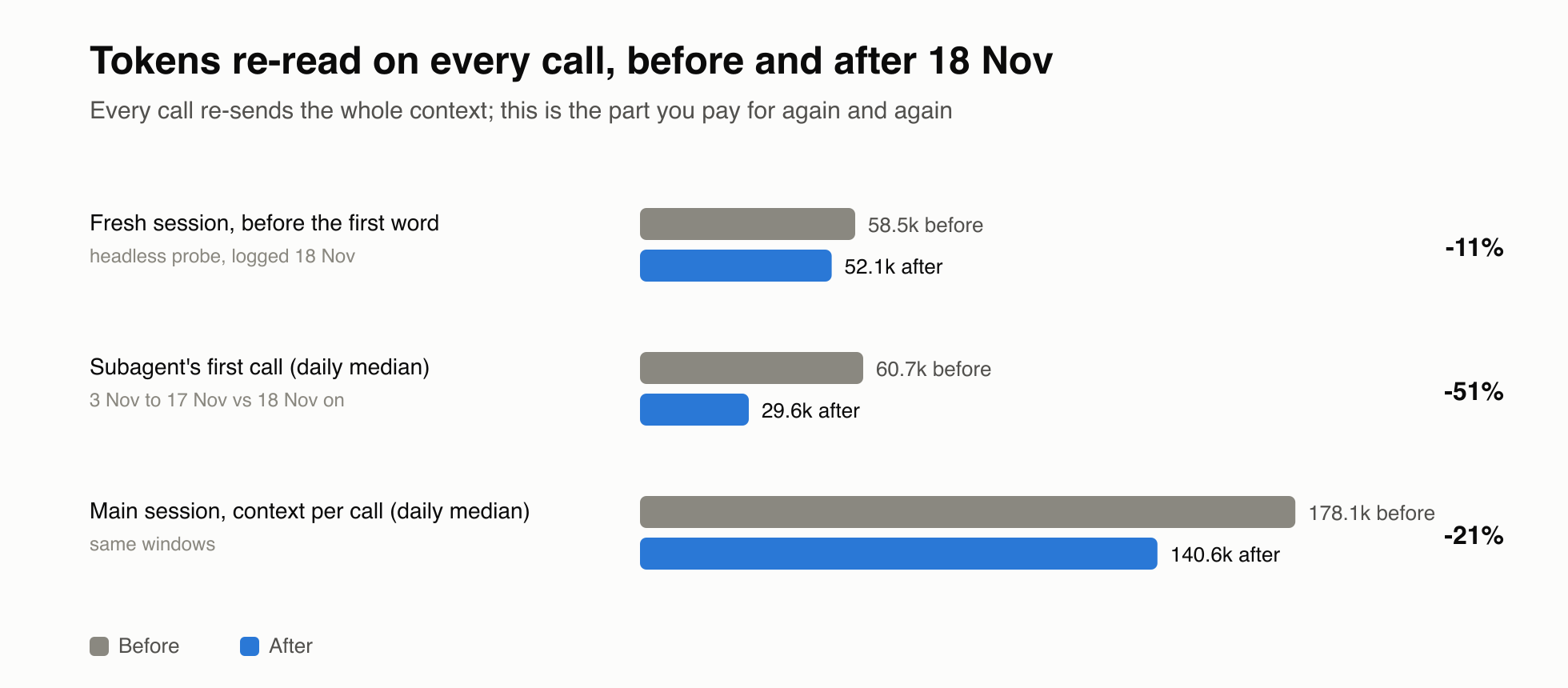
Tokens re-read on every call, before and after 18 Nov. Fresh session 58.5k to 52.1k (-11%); a subagent’s first call 60.7k to 29.6k (-51%); main session context per call 178.1k to 140.6k (-21%). The fresh-session bars are a clean headless probe; real sessions start higher.
These bars are tokens, not units; most are cache reads at a tenth each. The first pair is a clean scripted session; my real sessions load more and fell only 5% (74.8k to 71.4k). After the second round of cuts the same probe reads 41.6k (24 Nov); the real sessions are not measured yet. The savings are in the other two. For the last one, a weekly tuner moved the point where the agent summarises and restarts its conversation from 300k to 225k tokens, because bigger windows cost more per call (17.7k units at 200k, 34.1k at 600k).
| Per call, quota units | 24 Oct to 2 Nov | 3 to 17 Nov | 18 to 22 Nov |
|---|---|---|---|
| Main session | 32k to 53k | 19k to 25k | 16.7k to 17.3k |
| Subagents | 26k to 38k | 17k to 22k | 13k to 16.5k |
| Subagent first call (median, tokens) | about 53k | about 61k | about 30k |
Then why did the bill not drop?
Because I spent the savings twice.
First on volume: about 1,400 calls a working day in late October, 2,800 in early November, 4,000 last week. Nobody uses a faster tool to finish early; economists call it the Jevons paradox. The weekly allowance was always the ceiling, so the bill could not fall much. What fell is how fast a day burns through it, which is where the fourth day comes from.
Second on review.
The reviewer that reviews the reviewer
Since 21 October, every push to a pull request gets a review from a fresh Claude, run from a script: clean checkout, read-only tools, no memory of who wrote the code. Every finding must be answered before merge. It replaced CodeRabbit as the gate because CodeRabbit allows only a few reviews an hour for the whole organisation, and with agents opening pull requests all day I was waiting on the queue.
The point is not the gate, though. It is a bet on the codebase. Code that is reviewed this hard should end up more consistent, with clearer logic and more edge cases covered, and code like that is cheaper to keep: fewer bugs to chase later, less of the same fix made twice. If the bet is right, review is the one line item that pays for itself over time.
The plan is a loop. CodeRabbit still sees critical paths and a hashed one-in-five sample. On that sample I measure caught: of CodeRabbit’s real findings, how many Claude also raised. What Claude misses becomes a lesson for it, if it helps on unseen pull requests. What both keep finding becomes a rule in a pre-PR self-check, the lever from the last post: stop defects arriving.
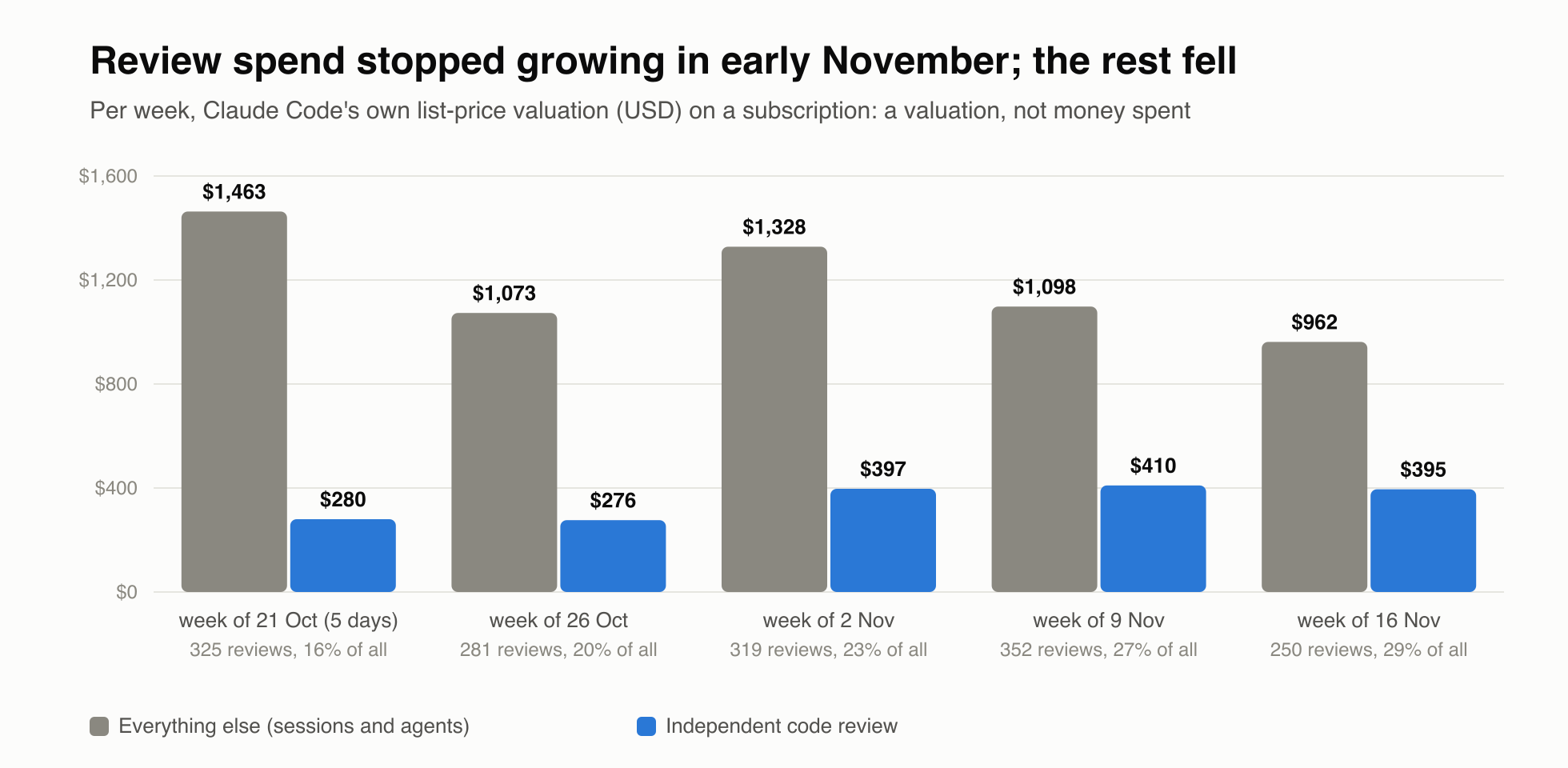
Weekly spend at list-price valuation, independent review against everything else. Review: $280 (first 5 days), $276, then $397, $410 and $395 in the weeks of 2, 9 and 16 Nov. Everything else: $1,463, $1,073, $1,328, $1,098, $962. Reviews per week: 325, 281, 319, 352, 250.
Review spend stepped up once, in the week of 2 November, from about $280 to about $400 a week, and stayed there. The number of reviews did not grow. Against the last week of October, review is up $119 a week and everything else down $111: the diet paid for the reviewer. In between, the bill rose to $1,725 in the week of 2 November and $1,507 the week after, before falling back. Its share rose from 16% to 29% mostly because the rest shrank around it.
A single review got dearer, $1.25 to $1.55, but that is mix: two thirds of last week’s reviews hit one repository where a review costs $1.76. Elsewhere the price held ($1.13, then $1.17).
How is it doing? Mixed.
- Works: the second round finds a third as many problems as the first (8.1, then 3.0), and six in ten serious findings (265 of 426) come in round one. After that it flattens at about two findings a round; a pull request merges when what is left is minor. CodeRabbit’s load fell from 27 of 93 pull requests a week to 8 of 50.
- Not yet: first-round findings are rising (5.4 to 9.1 a pull request), and I cannot yet tell a stricter reviewer from bigger changes. Caught fell from 0.47 to 0.22 on ever smaller samples (30 commits, then 8). All four proposed lessons failed the held-out test. And the self-check barely bites: at most 7% of findings a week are mechanical. The top repeat offenders are stale comments, prose that contradicts the code, and “every” meaning “most”. Those need a reader, not a regex.
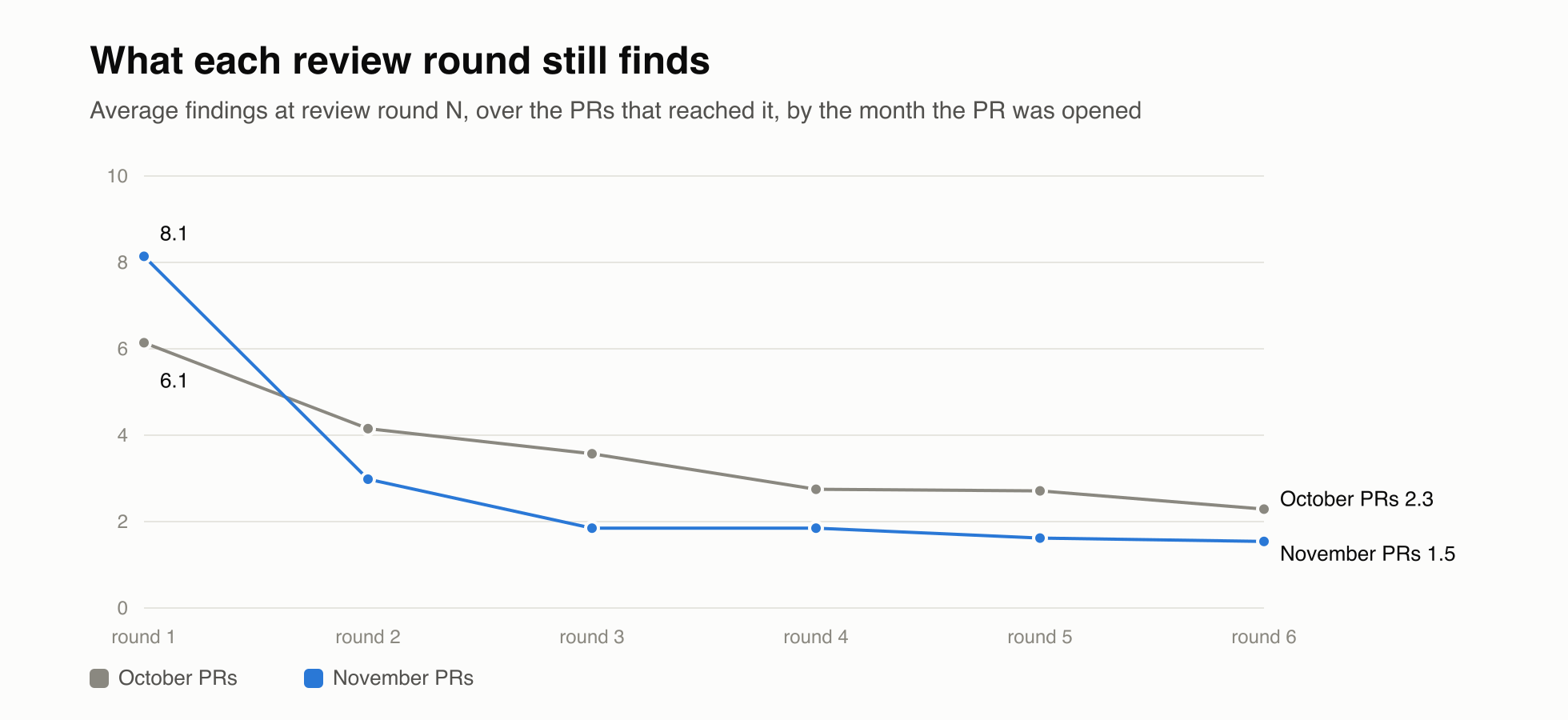
Average findings at review round N, by the month the PR was opened. October PRs: 6.1 at round 1, 2.3 by round 6. November PRs: 8.1 at round 1, 3.0 at round 2, 1.5 by round 6.
| Review loop | Late October | Mid November |
|---|---|---|
| Review spend per week | $276 (week of 26 Oct) | $395 (week of 16 Nov) |
| Everything else per week | $1,073 (week of 26 Oct) | $962 (week of 16 Nov) |
| Review share of the bill | 20% (week of 26 Oct) | 29% (week of 16 Nov) |
| First-round findings per PR | 5.4 (week of 19 Oct) | 9.1 (week of 16 Nov) |
| PRs that CodeRabbit reviewed | 27 of 93 (week of 19 Oct) | 8 of 50 (week of 16 Nov) |
| Caught | 0.47 (week of 26 Oct, 30 commits) | 0.22 (week of 9 Nov, 8 commits) |
What I take from it
The diet worked where it was aimed: a call costs half, a delegated agent starts at half the context, and the same allowance covers four working days instead of three. The rule underneath is structural (knowledge goes where it is used; always-loaded files only point), and it needs a limit a machine enforces, because left alone the index regrew in two days.
The bill stayed flat because I spent the savings on more work and a second pair of eyes for all of it. I think that is the right trade. But nearly 30% of the spend is now one line item, and the bet behind it has not shown up yet. If the code is getting easier to keep, findings per pull request should fall; so far they are rising. That is the number to watch. Next: make reviewing a one-line fix cheaper than reviewing the whole pull request, and give the reviewer the same short instructions everyone else got.
All figures are re-derivable from this post’s data/ folder: extract_usage.py (transcripts, daily aggregates only), extract_always_loaded.py (config history), extract_reviews.py and extract_review_mix.py (review log and telemetry), plus the review dashboard’s weekly tables. Quota units are my own weights, not prices; dollar figures are list-price valuations on a subscription, not money spent. The three-to-four days is read off the subscription’s weekly limit meter. Phases are dated by the configuration commits of 3 and 18 November 2026.
