
I started using Claude Code in December last year. In four months, I’ve delivered what my team would have needed two or three years to ship — at least. That sounds like a happy ending. It isn’t quite.
In my previous post I wrote about the builder role — how AI collapses the developer, the engineer and the analyst into one person who can ship almost anything in an evening. That’s still true. What I didn’t talk about is the caveat that comes with it, and the new kind of tiredness that nobody warned me about.
Agents rarely get stuck
This is the part that quietly changes everything. Claude Code, given enough prompting and guidance, navigates uncertainty better than most humans I’ve worked with. It doesn’t sulk. It doesn’t ask for a coffee break. It doesn’t say “I don’t know” and trail off. It tries something, course-corrects, tries again. Almost any task gets to “done” with enough back-and-forth.
That sounds great until you realise what it removes from your day. The pauses are gone. The “I’m stuck, let me go for a walk” moments are gone. The half-hour brainstorm with a colleague where you both stare at a whiteboard and slowly arrive at an idea — gone. Those weren’t wasted time. They were the recovery built into the work.
Continuous delivery, continuous validation
What replaces the pauses is a steady stream of prompting and reviewing. The agent produces code; I read it, push back, redirect, accept, push the next prompt. Then the next. The friction that used to throttle output — typing speed, context-switch cost, the act of actually writing the lines — is gone. So output multiplies. And every line of that output needs to be looked at, because trusting an agent blindly is how you ship subtle bugs.
That second part is the trap. Volume goes up. So does the volume of validation. Each individual task is less tiring than building from scratch, but you’re doing many more of them, all at once, all the time. The total load doesn’t go down. It changes shape.
A different kind of tired
After a few days of this rhythm I noticed I was tired again — but differently than before December. The old tiredness was the tiredness of building: hours bent over a problem, debugging the same loop, fighting a library, re-reading the same documentation page for the fifth time. Heavy on focus, slow on output, with occasional bursts of progress and the satisfying exhaustion of a hard day.
The new tiredness is different. It’s the tiredness of constantly reading, judging, deciding. Was that change correct? Did the agent introduce a regression two files away? Is this design actually right or just plausible? Should I let it go further, or stop and rethink? It’s lighter per decision, but there are far more decisions, and they don’t space themselves out anymore. There’s no natural break point where you’d say “okay, that’s enough for today” — because the agent never gets stuck, the work never tells you to stop.
Two jobs in one
The honest description of what I do now: I don’t write code anymore. Not a single line. What I do is code review and design planning, all day. That’s the job a tech lead or a manager would do. But I’m still the builder — I’m the one accountable for the thing being shipped, working, correct. So it’s two jobs stacked on top of each other. Manager and builder, same person, same hours.
The throughput is wonderful. The work is genuinely good. But the rhythm is unforgiving. There’s no “stuck” anymore to give you a beat of quiet, no compile time, no waiting on a teammate’s PR. The agent is always ready. The next prompt is always one keystroke away. You have to be the one who introduces the pause, because the system won’t do it for you.
The rabbit hole
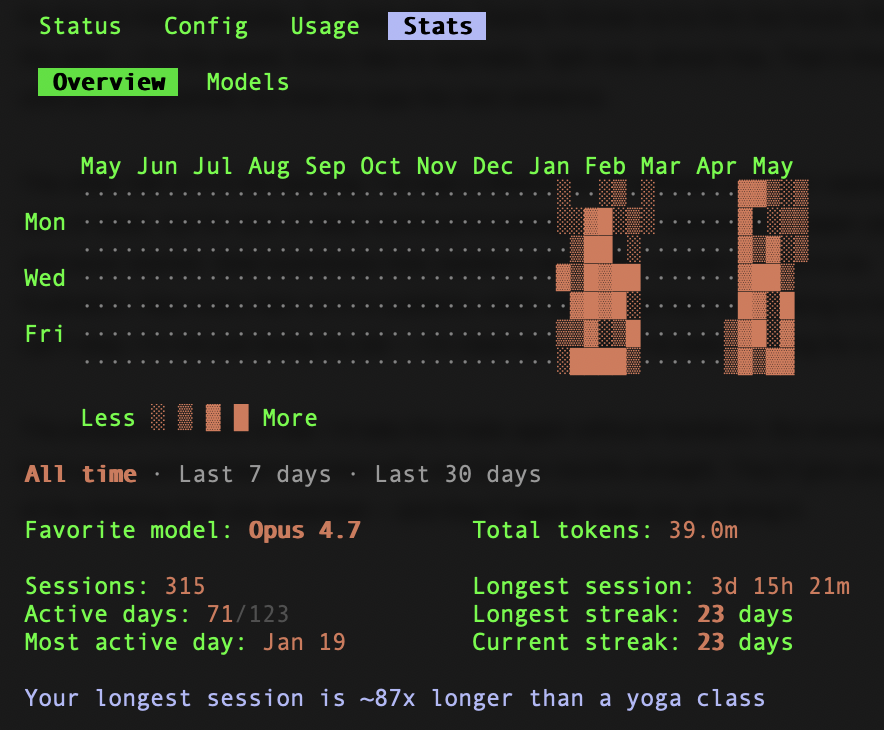
I’d love to tell you I’ve solved this. I haven’t. As I write this, the Claude Code stats screen tells me I’m on day twenty-three with no day off. 315 sessions. 39 million tokens. The longest single session clocked in at 3 days, 15 hours, 21 minutes. No mitigation, no hard stops, no protected day. Just one more prompt, one more review, one more “let me also fix this thing while we’re here.”
The agent itself sometimes hints that it’s late, that maybe this new task or this new design is something to pick up tomorrow. And it’s right. But I know how fast it is. I know that the thing it’s suggesting I defer would, if I just kept going, be done in twenty minutes. So I keep going. Twenty minutes turns into two hours, the way it always does. The pull isn’t the work — it’s the speed. Every idea is reachable, right now, almost free. That’s the rabbit hole. It’s hard to climb out until you’re genuinely too tired to type the next sentence.
The other half of it is the backlog. I’ve kept a lifetime list of software projects I wanted to build and never could — not for lack of ideas, but for lack of deep technical knowledge. Apps I sketched on paper years ago. Tools I described to friends and never started. Side businesses that needed a developer I couldn’t afford to be. That list used to be a quiet source of frustration. Now every item on it is suddenly within reach, and they’re all asking to be built at the same time. Of course I can’t stop. I’m not just doing my job — I’m clearing a queue I’ve been carrying for a decade.
Throwing away the scaffolding
Last month I deleted my bookmarks. All of them. From 793 to zero, across both my Google profiles — work and personal. They were almost all the same kind of thing: documentation on how to do something I’d had to fix once, links I saved so I wouldn’t have to figure it out again, half-finished backlog references, things I “needed to remember.” That whole layer of personal cache, gone. I don’t need it. If the same problem comes up again, I can describe it to Claude Code and have a working solution faster than I could have searched my own bookmarks for the link. A few hundred have crept back into Chrome since — but they’re working bookmarks for the projects I’m in right now, not an archive of “in case I ever need this.”
Same story with the BI dashboards we deleted last week. They represented an enormous amount of work — and I don’t care, because I could rebuild them better, in a fraction of the time it took to build them in the first place. The old ones were monuments to a constraint that no longer exists. Holding onto them was a habit, not a need.
One part of the brain unlocked, another locked
It isn’t all tiredness, though. The other half of this trade is energy I genuinely didn’t have before. The coding part of my brain — the one that used to be permanently busy debugging, reading docs, fighting tooling — has gone quiet. And in the space it left, I’ve found room for things I’d quietly given up on. I’m reading books again. I’m thinking about making music. I’m studying topics I never had the patience for after a full day at a keyboard.
It’s a strange swap. The load just shifted — review, judgement, decision-making is where it went. But on balance the trade lands in my favour. I have more energy to try new things than I did before, not less. The kind of energy that makes you curious enough to start something — which, per my last post, is the whole game now.
The productivity story is real. I’d take this trade again without hesitation. But anyone telling you AI agents will give you back your evenings hasn’t worked with one for four months straight. They’ll give you back the typing. They’ll take more of the thinking than you expected — and they’ll happily keep you up doing it.
